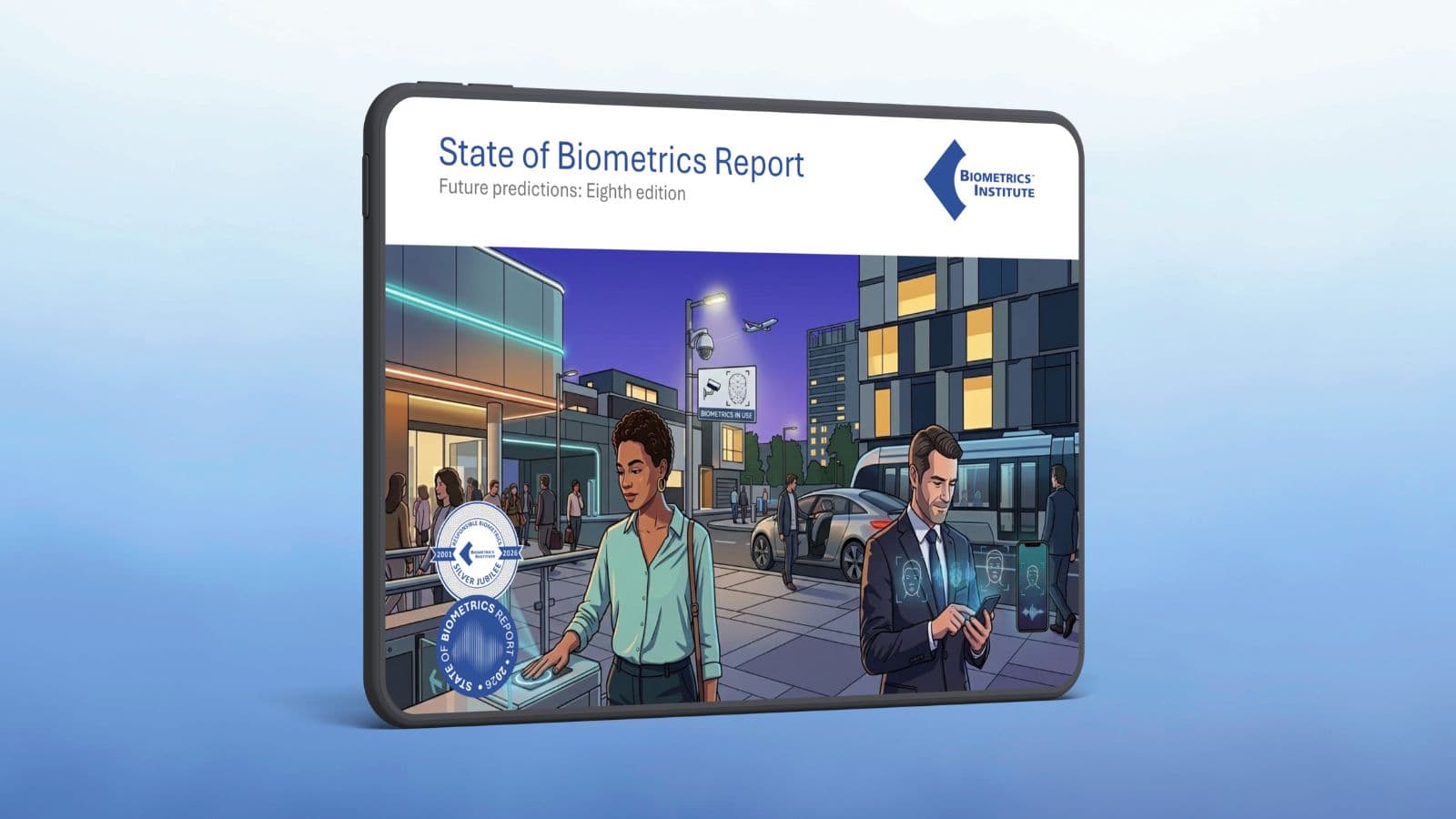
This overarching message sets the tone for the State of Biometrics Report 2026, published today by the Biometrics Institute. The new report explores how the global identity landscape has transformed over the past quarter-century and sets out actions required to manage the technology responsibly in an era defined by agentic AI and ubiquitous CCTV.
25 years of evolution sees biometrics move from border trials to everyday reality
Identity was a very different concept when the Institute was founded in 2001. Biometrics were largely limited to law enforcement and early border trials. It was an era dominated by passwords, PINs, and very few standards or regulations. Fast forward 25 years, and biometric collection is embedded across daily life, however while it delivers security and service efficiencies, risks remain which must be mitigated against.
Isabelle Moeller, Chief Executive of the Biometrics Institute, notes:
“25 years on, biometrics have moved from a promising idea to something used passively, everywhere, and every day. The next 25 years will be defined not by whether the technology works, but by whether we govern it responsibly. This year’s report examines how collection practices have matured across different use cases, societal choices around deployment, the evolving human role alongside agentic AI, and why biometrics acts as the trust multiplier for digital identity.”
Four essential themes for the future of biometrics
This year’s report unpacks where the industry stands and where it must go next across four core themes:
The first theme explores the maturity of collection practices as collection spans a spectrum of intention and improvements in traditional uses. However, collection is a continuum, not a single moment. 54% of the Institute’s Industry Survey respondents highlighted privacy and data protection concerns as a key factor for biometric adoption. Managing this requires universally applicable guidance, such as the Institute’s Privacy Guidelines, which provide an ethical framework for safeguarding individual rights, ensuring collection is treated as a lifecycle throughout its use rather than separate events.
The second theme addresses whether we are creating big brotherhoods or cohesive communities. Institutions and communities face growing choices over whether, when, and how to deploy biometric technology to solve shared problems like retail crime and community safety. Balancing speed-to-decision with proportionality, transparency, and secure-by-design principles remains vital as deployments accelerate.
The third theme examines the human in the loop v2.0. In a landscape shaped by deepfakes, synthetic identities, and agentic AI, the challenge is shifting from simple identification to proving humanness. The next generation of human reviewers will need to detect AI-generated faces, morph attacks, synthetic identities and real-time deepfakes. Reflecting this shift in the Institute’s Industry Survey, over half of those surveyed – a significant rise on last year – believe that as AI improves, human oversight in the decision-making loop will become even more important.
The fourth theme focuses on biometrics as the trust multiplier. Trust remains the catalyst that moves digital identity into the global arena. Biometrics alone doesn’t deliver all that, but biometrics is the critical mechanism for establishing the trust that digital identity depends on.
Building trust and the Three Laws of Biometrics
Looking ahead, the next 25 years will be defined not by whether the technology works, but by whether we govern it responsibly.
To ensure long-term trust and accountability, the Institute encourages all stakeholders to follow the Three Laws of Biometrics, starting with the policy first, followed by process, and then technology.
The full State of Biometrics Report 2026 provides a deeper insight into the four themes, provides relevant media headlines, Industry Survey results enforcing the messages and a full page on “what we should do about it”.
The report will form the basis for learning and discussion amongst Institute members throughout the next 12 months. It is an essential tool to be prepared for what is next on the horizon. It is now available as a resource for Biometrics Institute members, with supplementary good practice guidance material. Join our community promoting responsible biometrics now to access this essential report.
ENDS.
About the Biometrics Institute:
The Biometrics Institute is the independent and impartial international membership organisation for biometric users and other interested parties. Established in 2001, the Institute celebrates its Silver Jubilee in 2026, marking 25 years of promoting the responsible, ethical and effective use of biometrics. It has offices in London and Sydney.
The member register, which represents a global and diverse multi-stakeholder community, lists over 200 membership organisations from 44 countries. It includes banks, airlines, government agencies, biometric experts, privacy experts, suppliers, academics, and 21 Observers representing United Nations agencies, IGOs, and European Union institutions.
The Biometrics Institute connects the global biometrics community. It shares knowledge with its members and key stakeholders and, most importantly, develops good practices and thought leadership for the responsible, ethical and effective use of biometrics.
For more information, please email Marco Lombardi.